Our History
Nearly a century at the heart of Westwood Village
Nearly a century at the heart of Westwood Village
When Holmby Hall opened its doors in 1929, it wasn't just a new building — it was the cornerstone of an ambitious experiment in American urban planning. The Janss Brothers were building only the second planned suburban shopping district in the country, and Holmby Hall would be its anchor.
The Janss Investment Company was a family-run Los Angeles real estate firm that operated for a full century, from 1895 to 1995. Brothers Edwin Janss Sr. and Harold Janss didn't just develop land — they created communities.
Their most ambitious project was Westwood Village, envisioned as a vibrant commercial district to serve the new UCLA campus. Harold Janss personally selected the first slate of businesses and determined their locations. He mandated that every architect follow a Mediterranean theme — clay tile roofs, decorative Spanish tile, paseos, patios, and courtyards.
Despite opening during the onset of the Great Depression, the Village thrived. It grew from 34 businesses in 1929 to 452 by 1939.
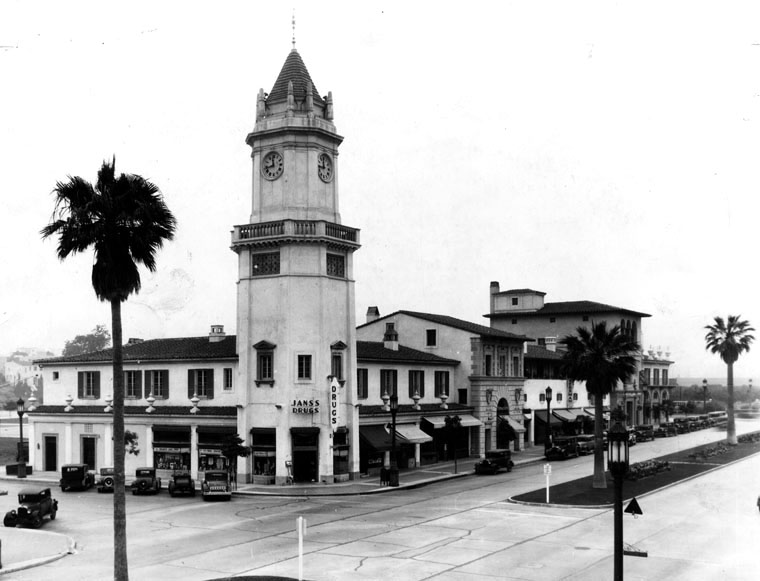
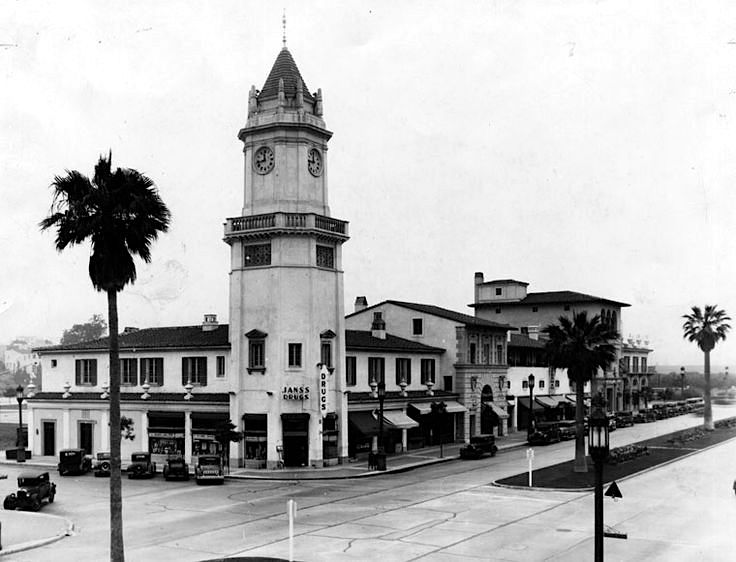
The Holmby Building, 1932
"This isn't just the sale of a building — it's the transfer of a cultural landmark."Tanel Harunzade, Kidder Mathews
Holmby Hall was designed by Gordon B. Kaufmann, collaborating with the legendary firm of Parkinson & Parkinson. Kaufmann is one of the most significant architects in California history — his portfolio reads like a guide to Los Angeles landmarks.
He designed the Hoover Dam (1931–36), Greystone Mansion in Beverly Hills (1928), Santa Anita Park racetrack (1934), and the Los Angeles Times Building (1935), which won a Gold Medal for Architecture at the 1937 Paris Exposition. The Parkinson firm was equally renowned, responsible for Los Angeles City Hall and Union Station.
Kaufmann's design for Holmby Hall blends Spanish Colonial Revival with an English-Norman clock tower — a unique hybrid that architectural historians have described as a "Gothically capped Classical clock tower," making the building an architectural conversation piece that defies easy categorization.
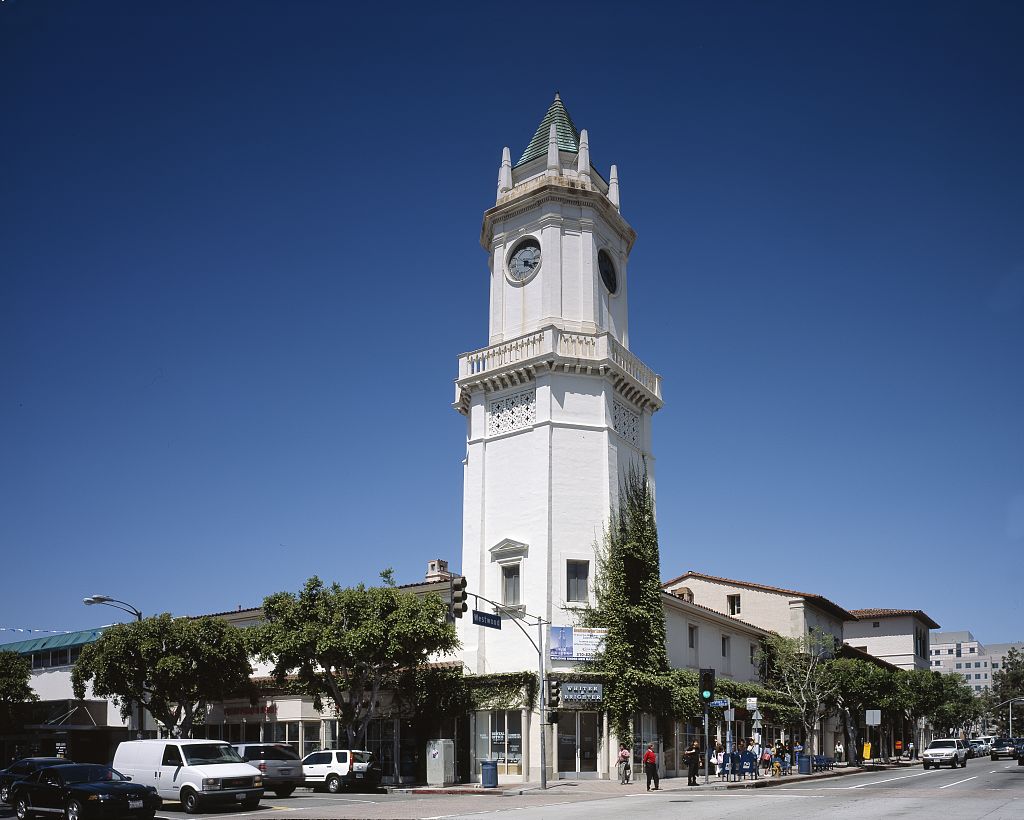
Clock tower, photographed by Carol M. Highsmith for the Library of Congress
When UCLA moved to its Westwood campus in 1929, the UC Regents only had enough funding to construct four campus buildings. They asked the Janss Brothers to provide student housing — and the brothers delivered.
Holmby Hall's upper floors became UCLA's first dormitory for female students. While young women studied and slept upstairs, the ground floor bustled with shops and the original Janss family drugstore and lunch counter — a corner storefront that survived well into the 1980s.
This dual identity — campus residence above, village commerce below — defined Holmby Hall's character from day one and forged the building's inseparable bond with the university across the boulevard.
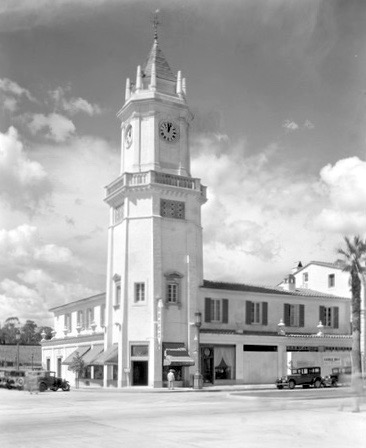
Corner of Westwood Blvd and Weyburn Ave, circa early 1930s
Rising approximately 110 feet above Westwood Boulevard, the clock tower is the most recognizable feature of the Westwood Village skyline. With its hexagonal form, copper roof, and green pinnacle, the tower has served as a wayfinding beacon for nearly a century.
The building itself is composed of five interconnected two- and three-story segments that span an entire block — from Weyburn Avenue to Le Conte Avenue — with the clock tower anchoring the southeast corner. Locals have long referred to the entire building simply as "The Clock Tower."
A comparison between photographs from 1932 and today reveals that the building has remained remarkably unchanged — a testament to the quality of its original construction and the care of its stewards.
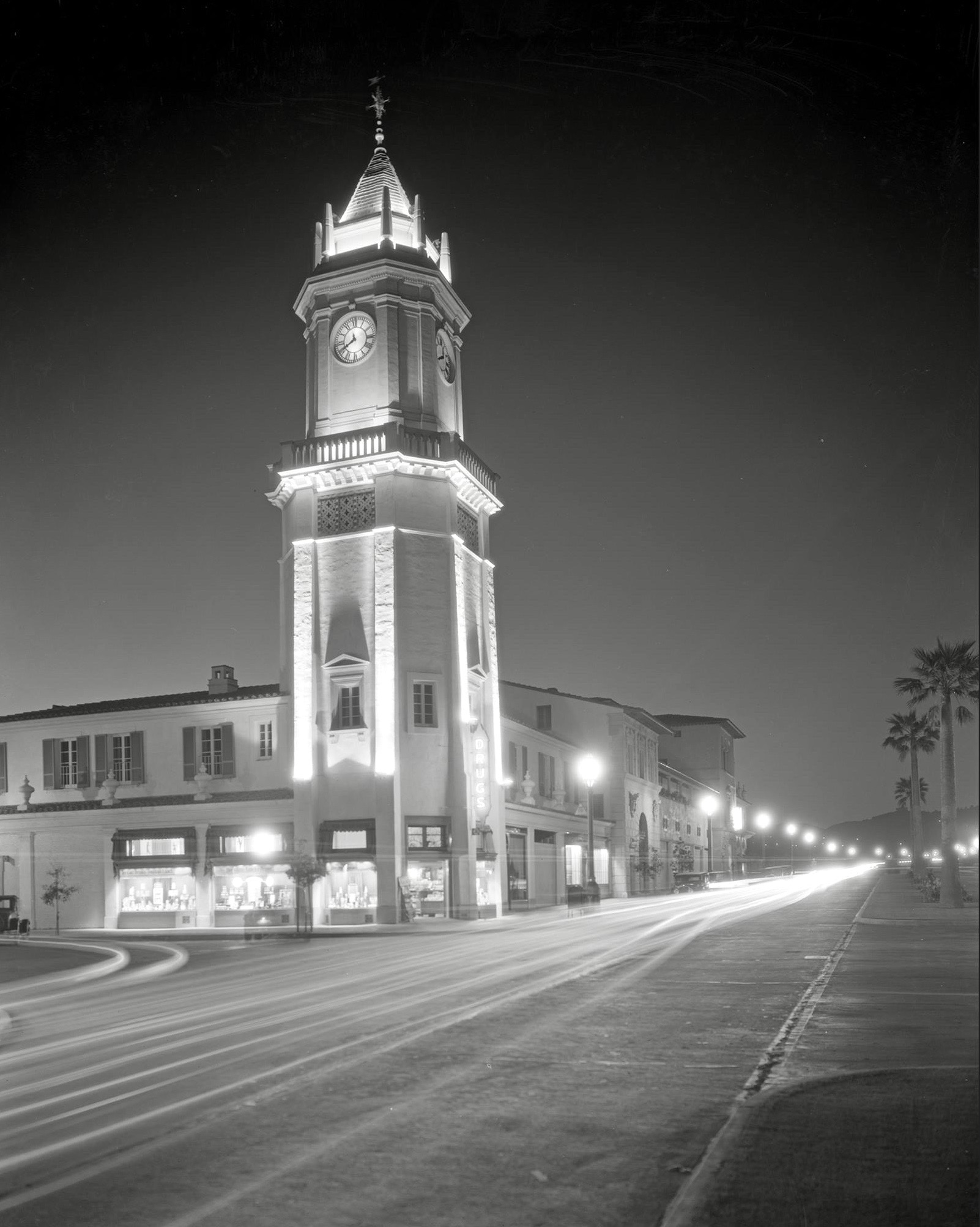
Night view of the clock tower, vintage photograph
In 2020, Holmby Hall was designated a Los Angeles Historic-Cultural Monument, formally recognizing what Westwood has always known — this building is irreplaceable. The Library of Congress holds its photograph in its permanent collections, and the Huntington Library preserves its architectural archives.
Today, Holmby Hall continues to evolve. Acquired in 2025 by new stewards committed to its preservation, the building is undergoing thoughtful upgrades while maintaining the historic character that makes it, in the words of the Westwood Community Council, "literally one of a kind" and "a crown jewel" of Westwood Village.
Nearly a century after the Janss Brothers laid its foundation, Holmby Hall remains what it has always been: the starting point. The place where Westwood Village began, and where its future continues to unfold.
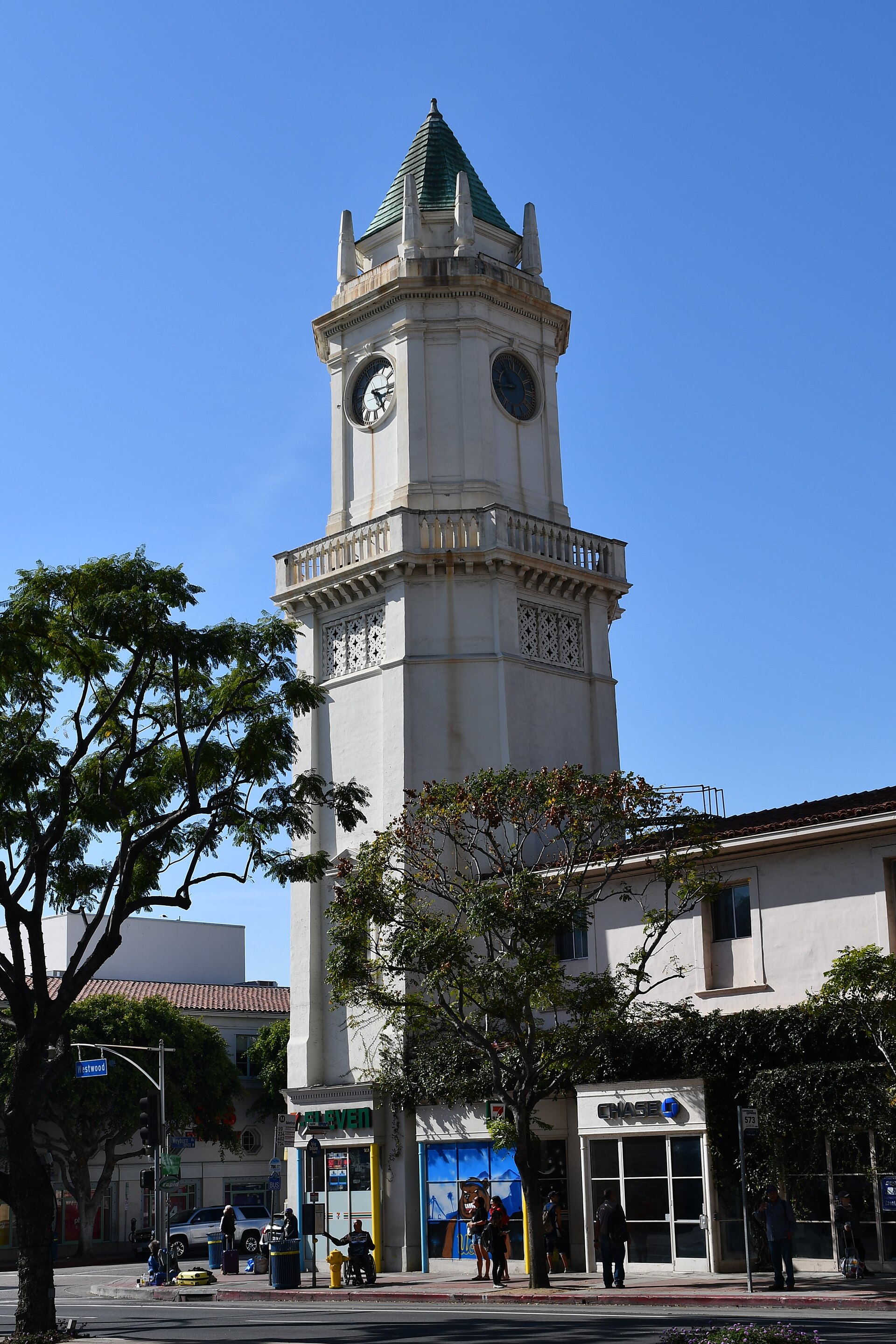
Holmby Hall today. Photo: Simon Cobb, 2020